Crowns
Dental Services
Dental Crowns: Restoring Your Smile’s Strength
eyeSmile Dental offers comprehensive care for your oral health. Whether you are dealing with decay or a recent injury, our customized dental crowns provide a durable, natural-looking solution.
Why You Might Need a Crown
A dental crown is typically recommended to address:
- Severe Decay: When a cavity is too large for a standard composite filling.
- Fractured Teeth: To hold a broken tooth together and prevent further splitting.
- Structural Support: To protect and strengthen a tooth that has weakened over time.
- Post-Root Canal Care: To seal and reinforce a tooth after a root canal.
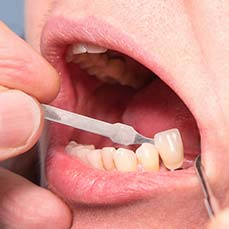
The Problem
- Badly decayed teeth
- Fractured teeth
- Need to protect and strengthen teeth

The eyeSMILE Solution
A crown (or “cap”) acts as a protective shield, restoring your tooth to its original shape and size. Our process ensures a perfect fit:
- Preparation: We remove any decay and thoroughly clean the area.
- Accuracy: A highly precise impression or digital mold is created to ensure your new crown fits seamlessly.
- Custom Crafting: This mold is sent to a specialized laboratory where your crown is custom-made from high-grade porcelain or zirconia.
- Final Placement: Once ready, the crown is cemented onto the prepared surface, sealing the tooth and preventing future decay.
The Benefits of Modern Porcelain & Zirconia
We specialize in porcelain & zirconia restorations that offer:
- Natural Appearance: Perfectly matched to the shade and shape of your existing teeth.
- Superior Durability: Laboratory-crafted for maximum strength to handle daily biting and chewing.
- Preventive Protection: Placing a crown early can prevent the need for more expensive implants or bridges later.
Porcelain offers a fine alternative to other tooth restoration materials. Made to perfectly match the shade and shape of your teeth, it’s durable, it’s strong, and it’s virtually undetectable.
Crowns are incredibly strong due to the fact that they are created in a laboratory. This protects and strengthens the remaining tooth structure. In the hands of a skilled dentist, a crown will fit almost perfectly onto the prepared surface of the tooth, reducing the size of the seam between the crown and the tooth. This helps keep decay from eventually occurring under the crown.
Crowns should be placed before the tooth is so decayed that it may fracture. This can often help prevent the expense of root canal therapy in the future. It can also prevent the possibility that a fractured tooth may need to be removed, requiring the expense of a bridge or implant to replace the missing tooth.
Crowns are excellent restorations and have few disadvantages. They are highly durable, but they will eventually need to be re-cemented or replaced due to normal wear.
Occasionally, a tooth may still need root canal therapy after being crowned. However, this indicates that the interior of the tooth was already sick (infected) and would have eventually needed root canal therapy anyway.
In the event that a tooth is so decayed or fractured that it needs to be removed, the best alternatives to a crown are bridges and implants that replace the missing tooth.